
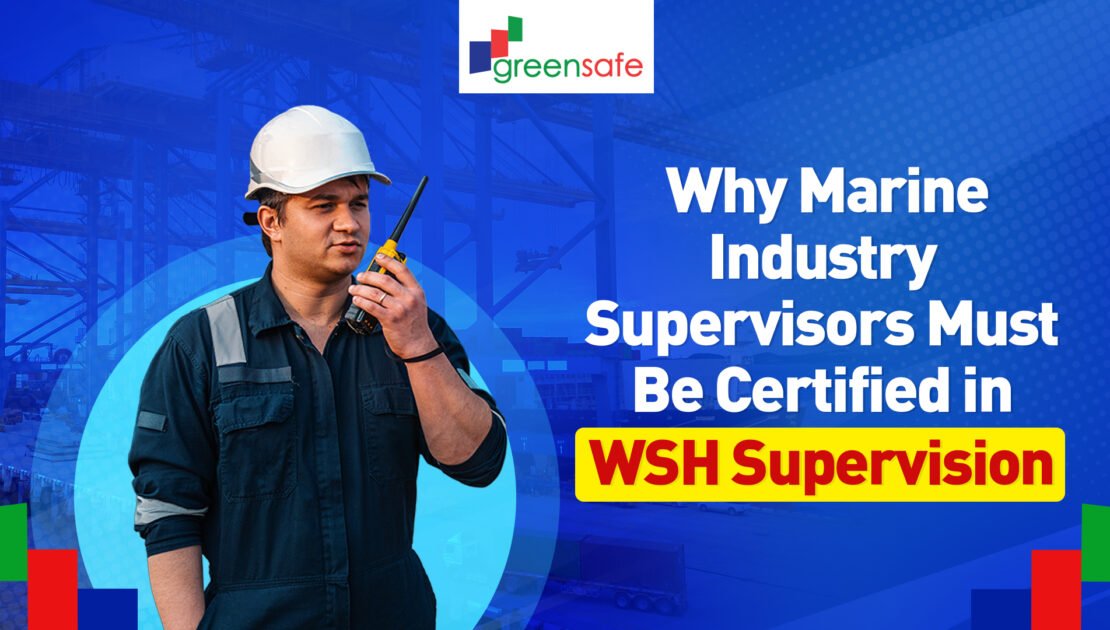
The maritime and shipyard sectors are one of the most dangerous and complex work environments throughout the entire world. Supervisors in this industry are subjected to safety hazards at all times, ranging from working on confined spaces and hot working, to heavy lifting and working at height. Proper training in such an environment is not optional, it is obligatory. This is why the certification in Workplace Safety and Health (WSH) supervision has become an urgent provision of any person who manages the operations within the marine sector nowadays.
Organizations are increasingly aware that safe operations rely on competent supervisors. Courses like the WSQ Supervise WSH in Marine Industry provided by Greensafe International equip the supervisors with the knowledge and competencies required to handle the risks effectively.
Understanding the High-Risk Nature of Marine Operations
Heavy machinery, hazardous materials and complex procedures characterize the marine sector, where risks abound if processes are not properly controlled. Ship building and repair operations often include entry into confining spaces, electrical servicing, surface treatment and “hot” (fire-producing) work. Failure to control these processes can put workers at high risk of serious injury or death.
Supervisors play a significant role in ensuring that all personnel follow safe procedures and identify hazards early. Even seasoned employees may fail to perform safety controls if proper training is not provided. Certification courses help provide supervisors with knowledge of legal responsibilities, identification of hazards and risk management procedures unique to the marine environment.
Regulatory Compliance Is Not Optional
Most jurisdictions, such as Singapore, have laws expressly stating that individuals should receive adequate safety training before supervising shipyard work. No individual should manage shipyard operations unless they are well-trained to conduct the work safely.
Workplace safety and health supervision certification assists organizations in proving compliance with legal expectations. It also reduces the vulnerability of penalties, stop-work orders or liability issues following workplace accidents.
Stronger Hazard Identification and Risk Control
Developing robust hazard recognition skills is a primary objective of WSH certification. The WSQ course equips participants to:
- Identify workplace hazards
- Evaluate and control risks
- Conduct safety inspections
- Investigate incidents
These competencies are critical because the majority of shipyard accidents are caused by unidentified or mismanaged risks. Properly trained supervisors can provide early intervention and implement control measures to prevent minor issues from becoming major incidents.
Improved Safety Culture Across Teams
Safety culture begins at the supervisory level; employees tend to reflect the attitude and behavior of their supervisor. A formally trained supervisor is better positioned to:
- Conduct proper safety briefings
- Implement permit-to-work systems
- Communicate risks clearly
- Lead by example
Marine industry courses mainly focus on the technical aspect rather than leadership roles. The participants are taught their responsibilities in ensuring safe working environments and coordinating with workers and contractors. Companies investing in safety supervisor training are likely to experience better compliance levels, reduced unsafe acts and workforce engagement.
Better Incident Investigation and Prevention
Even well managed work places experience accidents. The difference between high-performing organizations is their ability to research and learn from incidents.
Certified supervisors are trained to:
- Identify root causes
- Document findings properly
- Suggest precautionary measures.
- Take remedial measures.
This systematic approach ensures that incidents are not repeated and reinforces the overall management system. Lack of proper training can make the investigations superficial resulting in repeated risks and augmented risk of operation.
Enhanced Operational Efficiency
Safety training is an expense rather than an investment as some companies perceive it to be. As a matter of fact, qualified supervisors tend to enhance productivity.
Here’s why:
- Less downtime is because of fewer accidents
- Work disruptions are minimized by proper planning.
- Well defined processes reduce confusion
- Risk assessment enhances the workflow design
By understanding the safety operations, supervisors are able to strike a balance between augmented productivity and risk management. The outcome is the execution of projects in a smoother manner and a reduced amount of costly delays.
Career Advancement for Supervisors
For individual professionals, certification is vital as it opens doors to career opportunities. Many employers in the marine industry prefer or require supervisors to be recognized with WSH qualifications.
Completing structured safety supervisor training demonstrates:
- Professional credibility
- Technical competence
- Leadership capability
- Commitment to safety excellence
WSQ course participants receive a Statement of Attainment confirming their competency in Workplace Safety and Health (WSH) supervision once they have been successfully assessed. Obtaining this credential can enhance your job and promotion opportunities in a highly competitive job market.
Standardized Competency Across the Industry
Consistency is one of the significant benefits of formal certification. The practice of supervision can have a great deal of variation among projects and companies without any standardizing training.
WSQ aligned courses make sure that there is a universal understanding between supervisors in the marine industry on:
- WSH legislation
- Risk management processes
- Permit-to work systems
- Inspection procedures
This standardization enhances the coordination of the contractors, shipyards and the project stakeholders.
Why Choose Professional Training Providers
Not all training is equal. Credible providers develop their courses based on national competency framework and industry requirements. For instance, the WSQ Supervise WSH in Marine Industry course usually involves about 32 hours of formal learning and assessment, which is a combination of the classroom learning session and the assessment which is predominantly practical.
The trainers as well as realistic case studies are also applied by quality providers so that supervisors could use what they have learned in real worksites. Organizations that partner with established providers gain confidence that their supervisors meet recognized competency standards.
Final Thought
To conclude, with the help of organized safety supervisor training, organizations can develop a qualified workforce of supervisors that protects people, assets and project schedules. To practitioners, certification increases credibility and gives them an opportunity for career growth. As safety expectations rise globally, certified supervision is no longer a best practice, it is a necessity for any organization operating in the marine industry.
